
Chalk Track 1: The Sponge and the Angry Man.
What Michael Jordan is teaching me about a life worth living

If you are reading this, thanks for coming along for the journey. I am going to start sending a weekly email every Saturday morning with an idea, thought, or perspective I’m learning from history's best books or in the field of high-growth tech. I’m calling them “Chalk Tracks.” I hope you enjoy…okay, to the writing
Roy Williams was struck afterward by how little it took. One conversation with Jordan, and no one would ever outwork him again.
Early in his career at UNC, Jordan was seen as too casual and abrasive. His effort didn’t match his goals. He wanted to be the best, but his actions showed his immaturity.
Williams, then the assistant coach, challenged him on it. Jordan said he was trying as hard as everyone else. Williams told him that if he wanted to accomplish great things, trying as hard as everyone else wasn’t enough. He had to work that much harder than everyone else.
It’s advice we’ve all heard. What’s rare is what Jordan did with it.
Reflecting on it later, Jordan said: “My greatest skill was being teachable… I was like a sponge… even if I thought my coaches were wrong, I tried to listen.”
“My greatest skill was being teachable… I was like a sponge… even if I thought my coaches were wrong, I tried to listen.”
Most people believe Jordan’s drive was innate; something he was simply born with. The reality is that without a great coach in Williams, and without Jordan’s willingness to listen and adapt, he might have been successful, but nothing close to what he became.
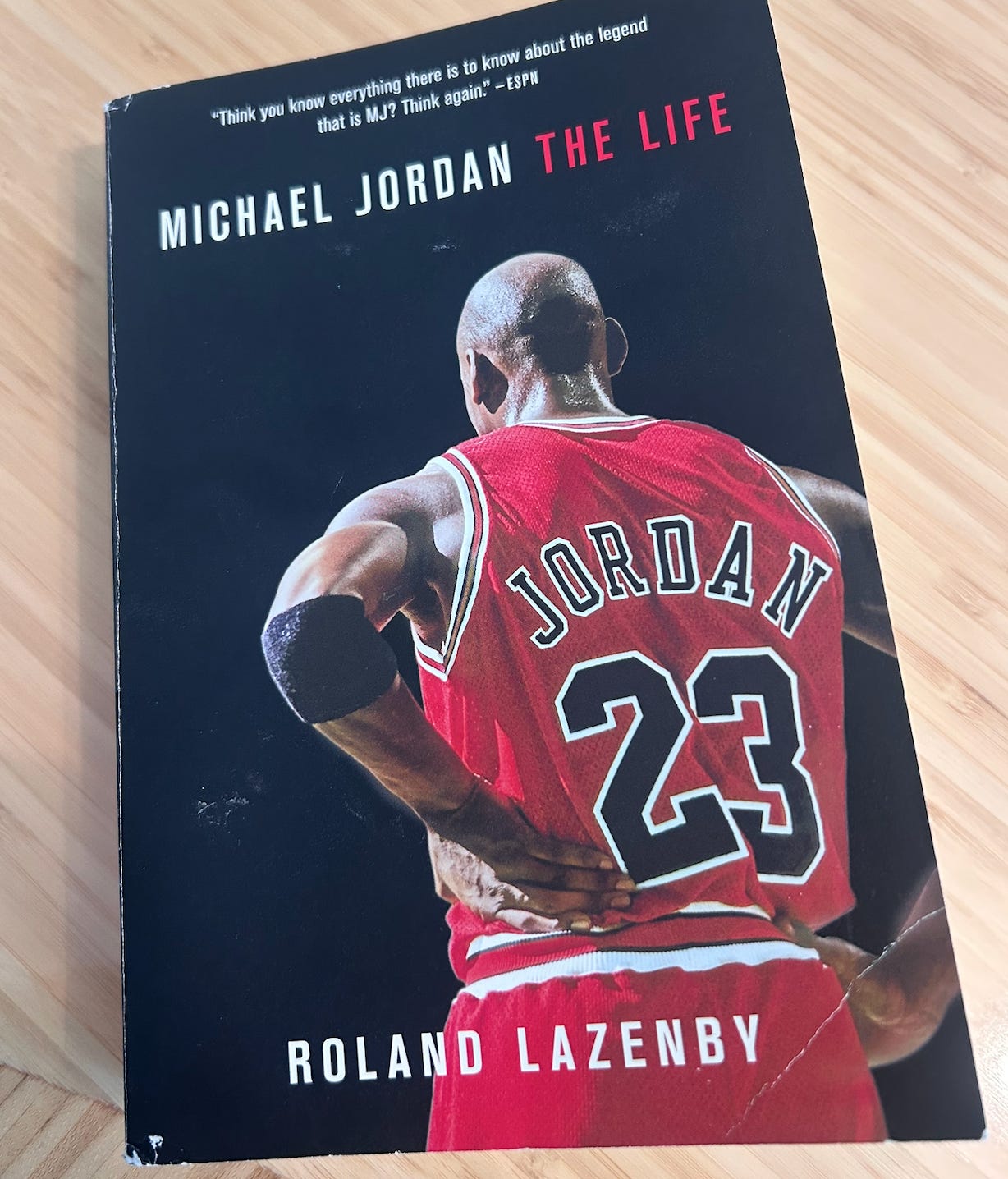
Recently, I came back to Roland Lazenby’s Michael Jordan: The Life. This book is arguably one of the best written about MJ, thanks to its personal insights into his upbringing. It shows how his father's fear imposed on the family fueled his relentless ambition and drive. Notably, one sentence stood out more than others, resonating so deeply that it has been identified as the core influence behind the famously competitive athlete.
“Just go on in the house with the women.”
From Lazenby:
“Of the millions of sentences that James Jordan uttered to his youngest son, this was the one that glowed neon-bright across the decades.
… “Years later,” his sister Deloris recalled, “during the early days of his NBA career, he confessed that it was my father’s early treatment of him and Daddy’s declaration of his worthlessness that became the driving force that motivated him.… Each accomplishment that he achieved was his battle cry for defeating my father’s negative opinions of him.”
The same teachability that made Jordan great is also what made the anger permanent. He was a sponge, but a sponge soaks up whatever it’s sitting in. He absorbed the coaching and the resentment, and he never wrung either one out.
I’ve been thinking about this a lot in my own life. Not only am I trying to be much more cautious with the words I use with my boys, but also working to uncover the beliefs or resentments that may be unconsciously driving my life.
What we absorb, absorbs us.
Jordan’s story ended with him as the greatest of all time; someone people around the world look to as an inspiration of dedication, perseverance, and craft. But what most people don’t see is isolation, the anger, and the negativity that still drive him today.
If you don’t believe me, watch his Hall of Fame speech and tell me that’s a happy man. I don’t know him. But to me, he looks like someone still trying to prove the world wrong, decades after he won.
So I have to ask myself the same question about my own ambition.
I have driven myself so hard to succeed in my professional life, but I have never stopped long enough to ask myself why I want to succeed in the first place.
What’s actually underneath it? Is it the love of the work? Or is it that I need to be seen as important?
When you look in the mirror, do you see someone with a genuine passion for your craft? Or do you see someone eager to show other people that you matter, that you are important, that you are worth their time?
For me, the answers are hard to face, but I am working on facing them, writing them down, exposing the flaws in my pyche that have been unconsciously ruling my mind for far too long.
I don’t want to wake up at 50 as a successful, angry, lonely man. Surrounded by everything I acquired, and none of what I actually wanted.
I won’t pretend I’m not ambitious. I am. I’m building something, and I want it to be excellent. The question isn’t whether to want greatness; it’s whether the work itself can be the reward rather than needing the outcome or approval of others.
I will never reach greatness the way Jordan did. I’ll never be widely known around the world. But my new north star is to be in the “Hall of Fame” in the minds of the people I care about the most. To have them be able to say that I lived my life, authentically, the way only I could.
It’s a high bar, but it’s worth chasing, don’t you think?